Overview
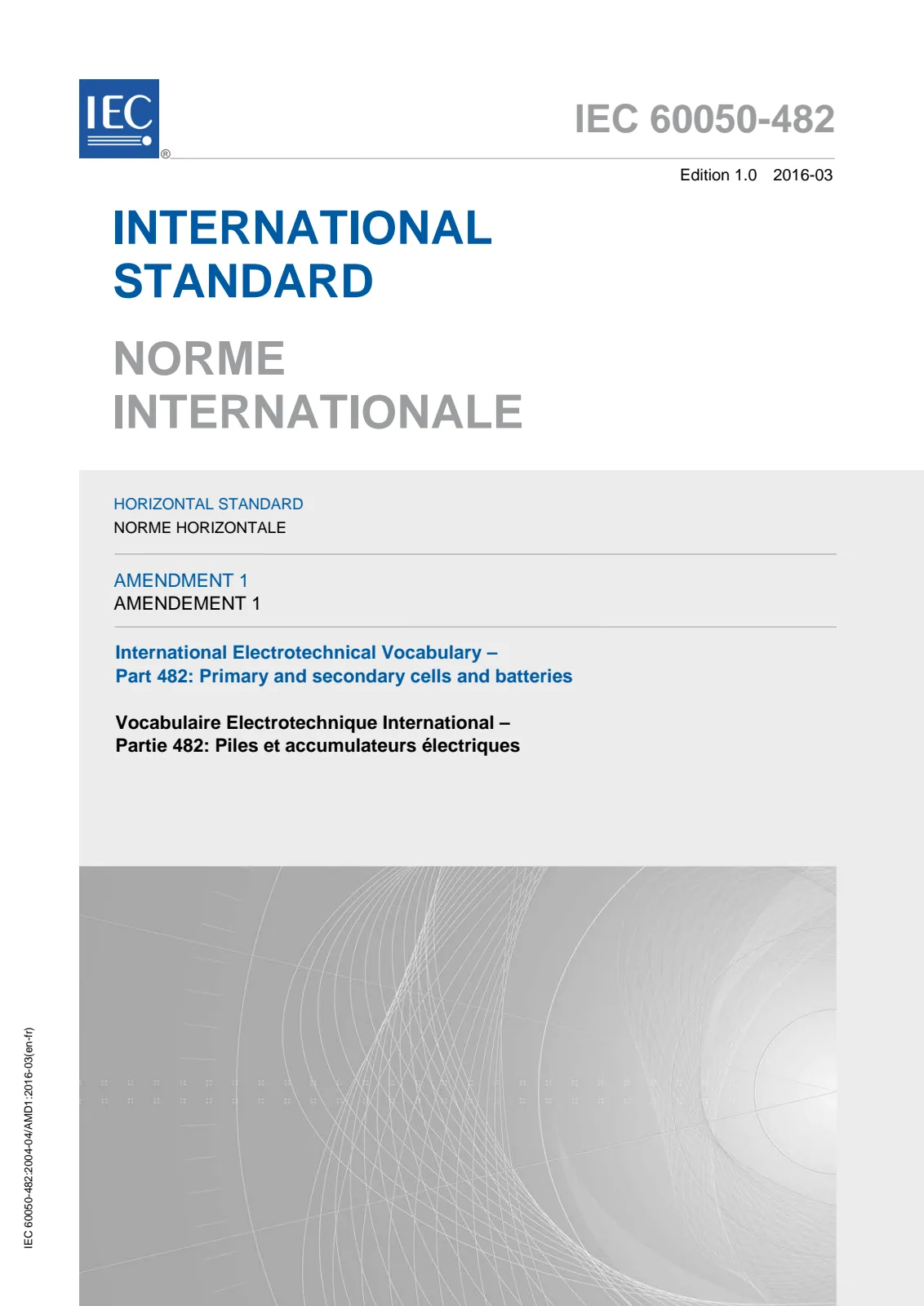
IEC 60050-482:2004, titled International Electrotechnical Vocabulary (IEV) - Part 482: Primary and Secondary Cells and Batteries, is a key horizontal standard published by the International Electrotechnical Commission (IEC). This standard provides a comprehensive and harmonized vocabulary covering the terminology related to primary (non-rechargeable) and secondary (rechargeable) cells and batteries. It addresses the technology, design, construction, electrical performance, and application aspects of cells and batteries to support international standardization and technical clarity across the electrotechnical industry.
By defining clear and universally accepted terms and concepts, IEC 60050-482 serves as an essential resource for manufacturers, engineers, researchers, and regulatory bodies engaged in the battery and energy storage sectors.
Key Topics
IEC 60050-482 organizes terminology into distinct sections, promoting systematic understanding and consistent communication:
- Fundamental Concepts (Section 482-01): Covers the essential principles and terminology foundational to primary and secondary cells, including definitions of key electrical and chemical concepts.
- Parts, Components, Accessories, and Shapes (Section 482-02): Details terms related to the structural and mechanical aspects of cells and batteries, including components and form factors.
- Electrical Properties and Operation (Section 482-03): Defines terms describing electrochemical performance, electrical behavior, and operational characteristics of batteries.
- Primary Cells and Batteries Terms (Section 482-04): Focuses on vocabulary specific to non-rechargeable cells and batteries, addressing their unique attributes and applications.
- Secondary Cells and Batteries Terms (Section 482-05): Addresses terminology applicable to rechargeable cells and batteries, including technologies used in their design and use.
Additionally, the standard provides bilingual definitions (English and French), along with term translations into multiple languages such as Arabic, Chinese, German, Spanish, Japanese, Polish, Portuguese, and Swedish, ensuring global accessibility.
Applications
This IEC vocabulary standard supports a broad range of practical applications in industry and research:

 Open preview (PDF)International Electrotechnical Vocabulary (IEV) - Part 482: Primary and secondary cells and batteries