Overview
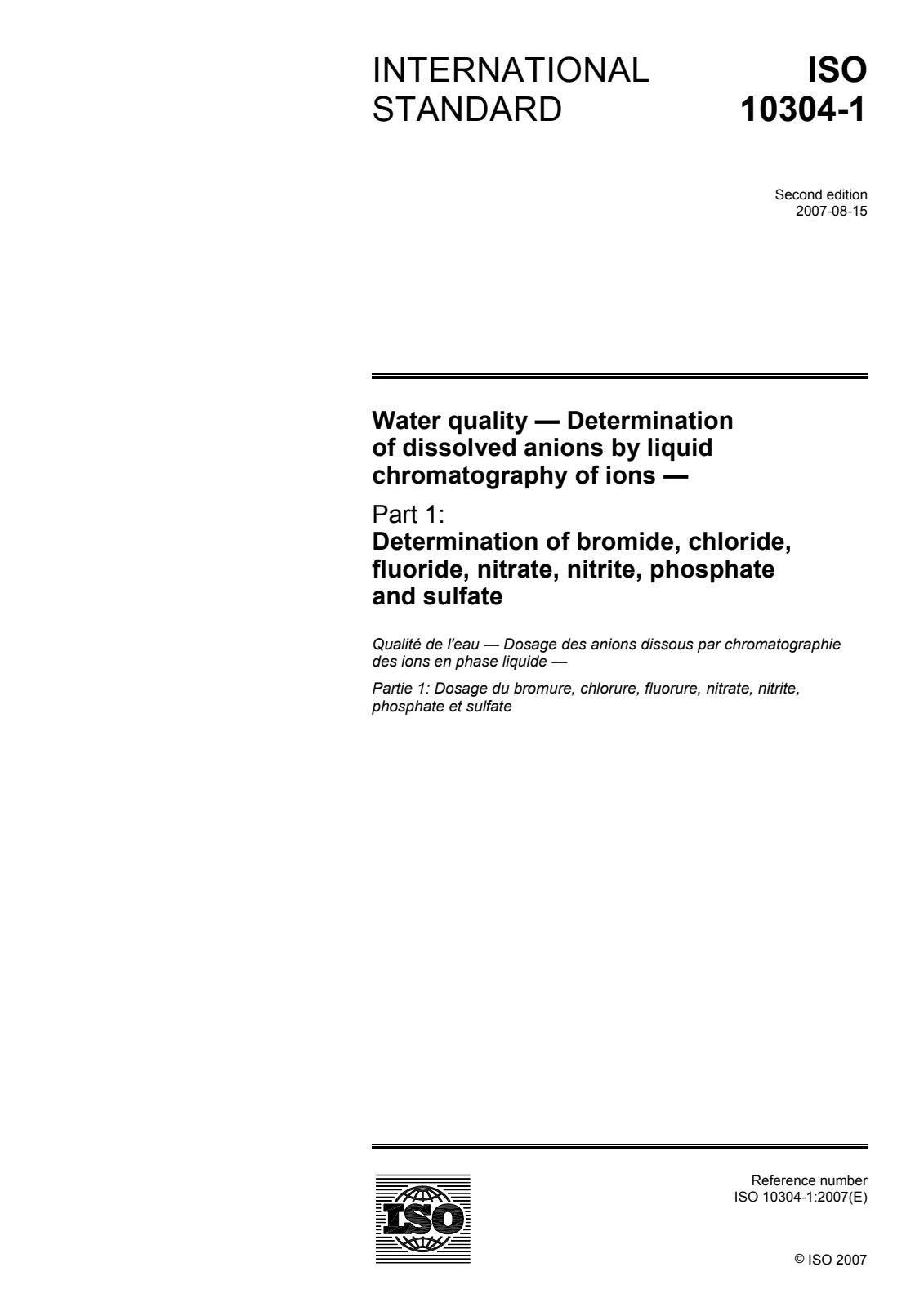
EN ISO 10304-1:2009 (adoption of ISO 10304-1:2007) defines a standardized laboratory method for the determination of dissolved anions in water by ion chromatography / liquid chromatography of ions. It covers measurement of bromide, chloride, fluoride, nitrate, nitrite, orthophosphate and sulfate in matrices such as drinking water, groundwater, surface water, wastewater, leachates and marine water. The method uses anion-exchange separation with conductivity detection (CD) and optional UV detection for selected analytes.
Key topics and technical requirements
- Scope and analytes: bromide, chloride, fluoride, nitrate, nitrite, orthophosphate, sulfate.
- Detection limits / lower limits of application:
- ≥ 0.05 mg/L for bromide and nitrite
- ≥ 0.1 mg/L for chloride, fluoride, nitrate, orthophosphate, sulfate
- Working range can be extended (e.g., ≥ 0.01 mg/L) with pre‑concentration or using a UV detector for bromide, nitrate and nitrite.
- Principle: anion-exchange LC with aqueous eluents (carbonate/hydrogencarbonate/hydroxide); separation on an anion-exchange resin.
- Detection: primary use of conductivity detectors with suppressors to lower eluent background; UV detection (200–215 nm) may be used for increased sensitivity for bromide, nitrate and nitrite.
- Sample pre-treatment: removal of solids, stabilization/removal of sulfite and problematic metal cations (use of cation-exchange cartridges where necessary).
- Interferences & remedies:
- Organic acids may affect separation.
- Sulfite can oxidize to sulfate - stabilize (pH adjustment and formaldehyde) if needed.
- Metals can require cation-exchange clean-up (note: H‑form cation exchangers can cause losses of fluoride and nitrite).
- Calibration & quality control: calibration per ISO 8466‑1 / ISO 8466‑2; control experiments, replicate determinations and standard additions recommended for matrix-affected samples.
- Reagents & apparatus: analytical-grade reagents and grade 1 water (ISO 3696); example eluents include NaHCO3, Na2CO3, NaOH, KOH.
- Safety & competence: tests should be performed by trained personnel following good laboratory practice.
Applications and users
- Routine monitoring of drinking water, wastewater, groundwater, surface water and marine environments.
- Compliance testing for regulators and utilities.
- Environmental monitoring programs, research labs and certified water testing laboratories.
- Instrument vendors and laboratories optimizing low‑level (trace) anion analyses using pre‑concentration or UV detection.
Related standards
- ISO 10304 series (Parts 3 & 4 cover other anions such as chromate, iodide, chlorate, chlorite).
- ISO 3696 (water for analytical laboratory use), ISO 5667‑3 (sampling, preservation), ISO 8466‑1 / ISO 8466‑2 (calibration and method evaluation).
Keywords: EN ISO 10304-1:2009, water quality, dissolved anions, ion chromatography, liquid chromatography of ions, bromide, chloride, fluoride, nitrate, nitrite, phosphate, sulfate, conductivity detector, UV detector, sample pre-treatment.