SIST ISO 15202-3:2005 PDF
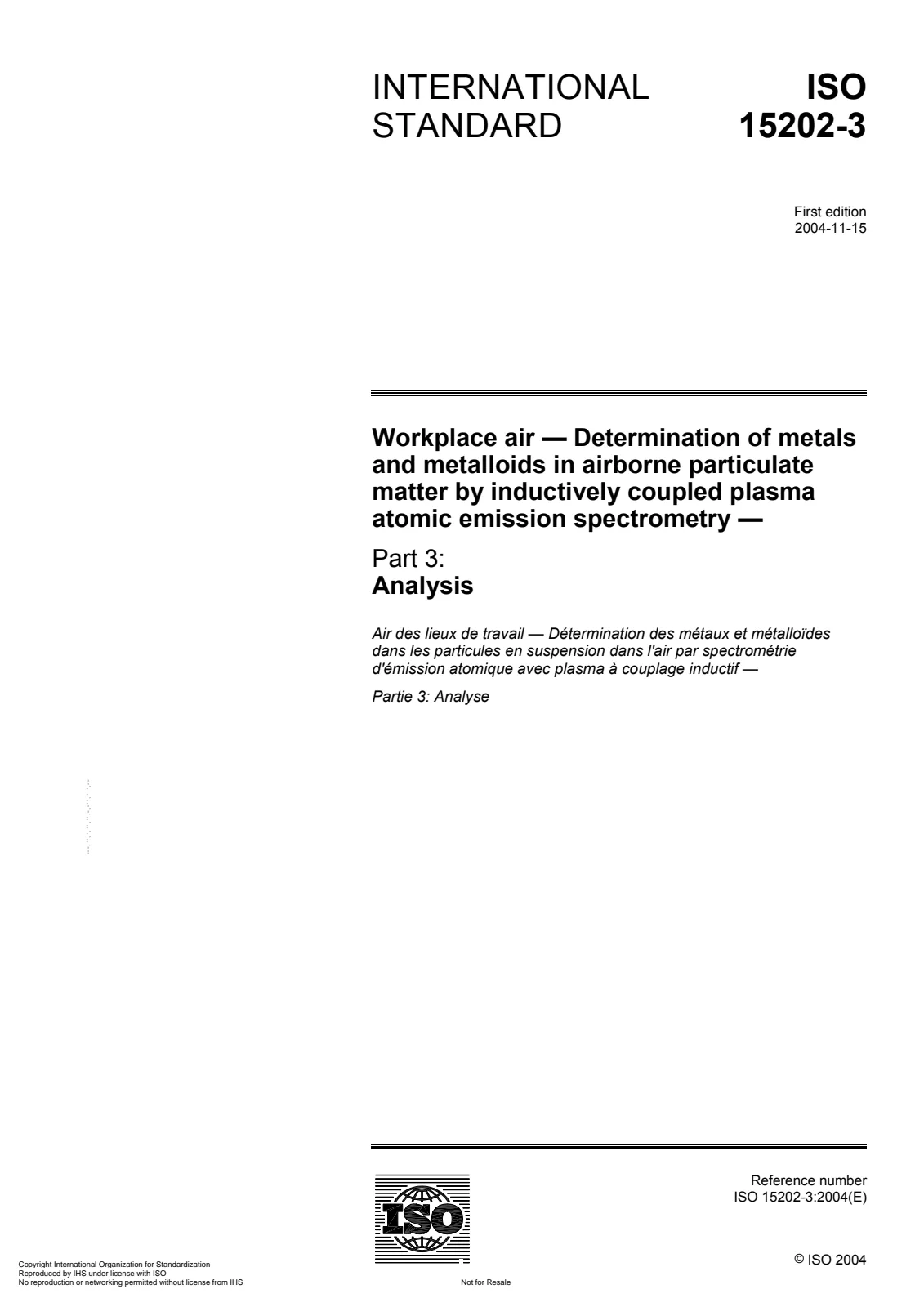
Workplace air -- Determination of metals and metalloids in airborne particulate matter by inductively coupled plasma atomic emission spectrometry -- Part 3: Analysis
Workplace air -- Determination of metals and metalloids in airborne particulate matter by inductively coupled plasma atomic emission spectrometry -- Part 3: Analysis
- Document status:
- Active
- Format:
- Electronic (PDF)
- Number of pages:
- 42
- Publication date:
- December 1, 2005
- ICS:
- 13.040.30
- Technical committee:
- KAZ - Air quality
ISO 15202-3:2004 prescribes a procedure for the use of inductively coupled plasma atomic emission spectrometry for analysing test solutions prepared as prescribed in ISO 15202-2 from samples of airborne particulate matter collected as prescribed in ISO 15202-1. Method development, performance checks and a routine analysis method are prescribed. The procedure suffers from no significant spectral interferences, provided that suitable analytical wavelengths are used. However, inaccurate background correction and/or inadequate matrix-matching can adversely affect results. ISO 15202-3:2004 is applicable to the following non-exclusive list of metals and metalloids for which limit values have been set; however, there is no information available on the effectiveness of any of the sample dissolution methods specified in ISO 15202-2 for those elements in italics: aluminium, antimony, arsenic, barium, beryllium, bismuth, boron, caesium, cadmium, calcium, chromium, cobalt, copper, hafnium, indium, iron, lead, lithium, magnesium, manganese, mercury, molybdenum, nickel, phosphorus, platinum, potassium, rhodium, selenium, silver, sodium, strontium, tantalum, tellurium, thallium, tin, titanium, tungsten, uranium, vanadium, yttrium, zinc and zirconium. ISO 15202-3:2004 is not applicable to determination of elemental mercury, since mercury vapour is not collected using the sampling method specified in ISO 15202-1. The results obtained may be used for the assessment of workplace exposure to metals and metalloids for comparison with limit values.
Technical details
- SKU
- SIST ISO 15202-3:2005