Overview
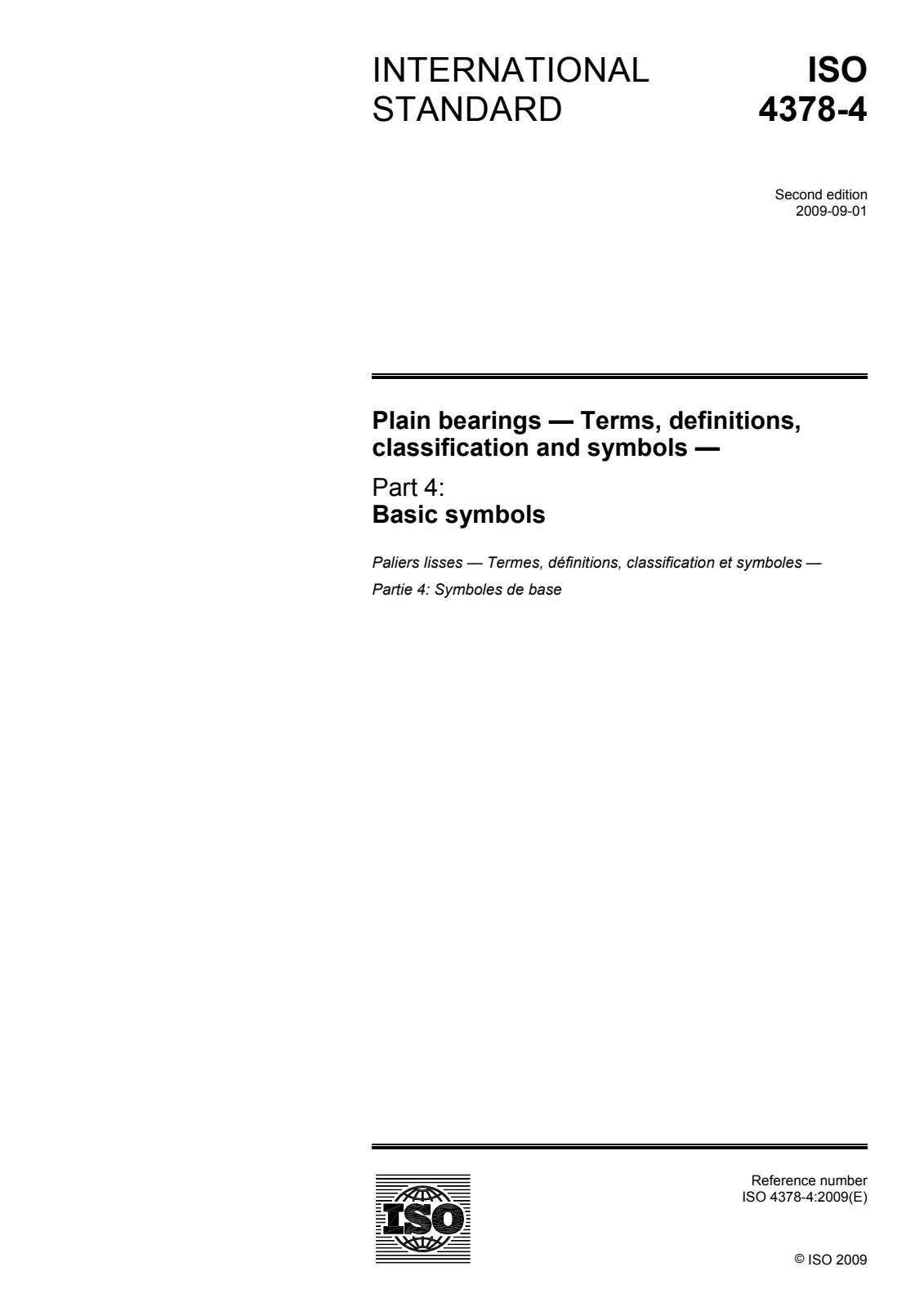
ISO 4378-4:2009 - Plain bearings - Part 4: Basic symbols defines a uniform system of symbols for plain bearings. It specifies the basic characters (Latin and Greek letters, Arabic numerals and selected signs) and the rules for their use with subscripts and superscripts. The standard aims to reduce ambiguity in technical literature, calculations and documentation for all types of plain bearings by standardizing symbol meanings and typography.
Key topics
- Scope and purpose: Establishes internationally applicable basic symbols and additional signs for plain bearings used in calculations, geometrical/technological determinations and quality assurance.
- Character sets: Uses characters from the Latin and Greek alphabets, Arabic numerals and auxiliary signs (points, commas, lines, asterisks).
- Typography rules:
- Variables in italic typeface; abbreviations in Roman type.
- Quantities with fixed values are designated by capital letters where possible.
- Angles and rotational directions are defined positively as left‑hand (anticlockwise).
- Subscripts:
- May contain 1–3 letters/digits.
- First letter normally corresponds to the first letter of the English term (e.g., h_lim for limiting film thickness).
- Combined subscripts separated by commas without spaces.
- Superscripts:
- Limited to characteristic signs (points, lines, commas, asterisks) with a maximum of two superscripts per symbol.
- Example usage: an asterisk indicates a parameter (F* for a bearing force parameter).
- Representative symbols: The standard lists common symbols and meanings (examples: A = area, F = force/load, N = rotational speed, h = thickness/gap, µ = coefficient of friction or relative stiffness, η = dynamic viscosity).
Applications
ISO 4378-4 is practical for:
- Bearing designers and mechanical engineers documenting calculations and design parameters.
- Tribologists and lubrication specialists standardizing variables for friction, wear and film thickness.
- Technical authors and standards writers who prepare specifications, test procedures and product datasheets.
- Quality assurance, metrology and test laboratories that require unambiguous notation for measurements and reports.
Benefits:
- Reduces misinterpretation in international engineering documentation.
- Simplifies indexing and differentiation of related quantities using subscripts/superscripts.
- Promotes consistency across design calculations, drawings and test reports.
Related standards
- ISO 4378 series (Parts 1–5): design, materials, friction and wear, lubrication, and Part 5: Application of symbols (normative reference for applying the symbols defined in Part 4).
Keywords: ISO 4378-4:2009, plain bearings, basic symbols, bearing symbols, subscripts, superscripts, bearing design, tribology, symbol standard.