Overview
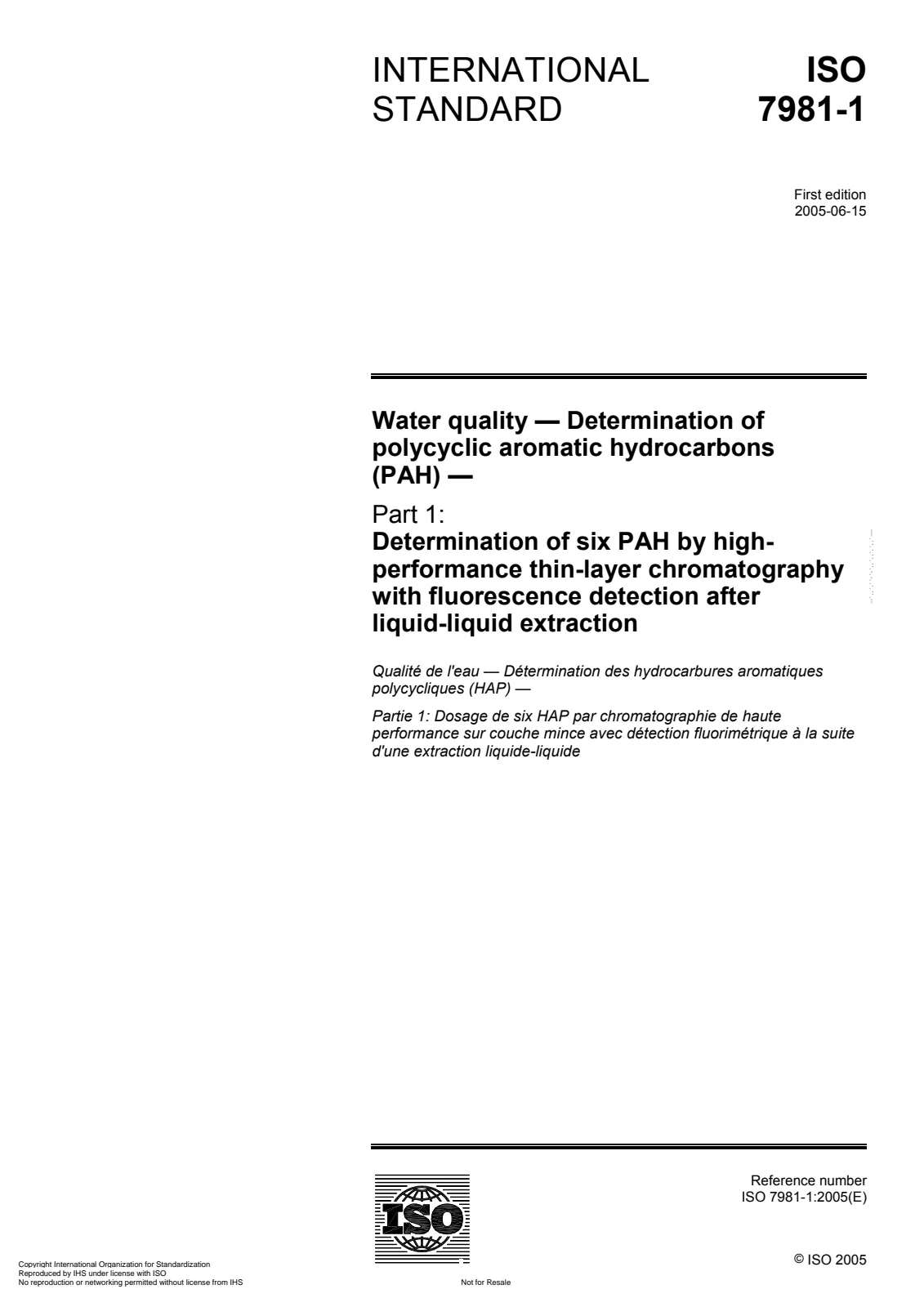
ISO 7981-1:2005 - "Water quality - Determination of polycyclic aromatic hydrocarbons (PAH) - Part 1" specifies a laboratory method to determine six priority PAH in drinking water. The method uses liquid–liquid extraction followed by separation with high-performance thin‑layer chromatography (HPTLC) and fluorescence detection. It covers both a rapid screening method (Method A) and a quantitative method (Method B) and can be adapted for ground waters and moderately polluted surface waters.
Key topics and technical requirements
- Target analytes: fluoranthene, benzo[b]fluoranthene, benzo[a]pyrene, benzo[k]fluoranthene, indeno[1,2,3‑cd]pyrene, benzo[ghi]perylene (sum of 6 PAH).
- Sample preparation: analysis of the whole water sample (particulate and dissolved fractions) via liquid–liquid extraction; coloured or contaminated extracts may require silica clean‑up.
- Detection: HPTLC separation on precoated silica (or RP‑18) plates with fluorimetric detection (UV lamp, TLC scanner); spectroscopic identification recommended to reduce false positives.
- Method performance:
- Screening (Method A): excludes samples containing less than 20% of referenced limit values.
- Quantitative (Method B): working range 40 ng/L to 240 ng/L for the sum of the six PAH; higher concentrations can be measured using smaller sample aliquots.
- Reagents and solvents: typical solvents include cyclohexane, hexane, dichloromethane, methanol, acetonitrile; high‑purity nitrogen, precleaned silica, and certified reference standards are recommended.
- Sampling and contamination control: use glass or steel containers (avoid plastics except PTFE), protect samples from light, dechlorinate if needed, and monitor blanks and recovery.
Applications
- Compliance testing of drinking water for PAH contamination and screening in water treatment and distribution systems.
- Environmental monitoring of ground water and moderately polluted surface waters after method adaptations.
- Routine laboratory quality control: calibration, blank measurements, and recovery determination as specified in the standard.
Who should use this standard
- Water quality laboratories performing regulatory or routine testing for PAH.
- Environmental chemists, municipal water authorities, public health laboratories, and contract testing labs.
- QA/QC managers and method developers implementing HPTLC‑based PAH analysis.
Related standards
- ISO 7981-2 (Part 2): HPLC with fluorescence detection for the same six PAH.
- ISO 5667 series: guidance on water sampling procedures referenced for sample collection.
Keywords: ISO 7981-1:2005, PAH determination, HPTLC, fluorescence detection, liquid‑liquid extraction, drinking water analysis, benzo[a]pyrene, environmental monitoring.