Overview
IEC 61249-4-19:2013 is an international standard published by the International Electrotechnical Commission (IEC) that specifies the requirements for high-performance, non-halogenated epoxide woven E-glass prepreg materials. These prepregs are primarily used as bonding sheets in the manufacture of multilayer printed boards, meeting the stringent demands of lead-free assembly processes. The standard covers prepreg materials of defined flammability, confirmed through vertical burning tests, and ensures a minimum glass transition temperature of 170 °C after curing.
This standard provides essential guidance for manufacturers and designers of multilayer circuit boards, ensuring the materials used have consistent thermal, mechanical, and flammability properties suitable for advanced electronic assemblies, especially those designed for safe, lead-free manufacturing environments.
Key Topics
- Material Type: High-performance, non-halogenated epoxide woven E-glass prepreg, specifically unclad and used in multilayer PCB manufacturing.
- Flammability Rating: Defined by vertical burning tests, with fire retardancy achieved through non-halogenated fire retardants embedded in the polymer matrix.
- Thermal Performance: Minimum glass transition temperature (Tg) of 170 °C post-curing, supporting thermal stability in lead-free assembly processes.
- Compatibility: Designed for use with laminates compliant with IEC 61249-2-40, it can also bond a variety of other laminate types.
- Quality Assurance: The standard mandates quality system requirements, inspection responsibilities, qualification inspections, and certificates of conformance.
- Physical Properties: Includes specifications for resin content, resin flow, electric strength, relative permittivity, dissipation factor, curing thickness, decomposition temperature, delamination resistance, and Z-axis expansion.
- Delivery and Packaging: Specifies forms of delivery including rolls, sheets, and cut panels, along with proper packaging and marking standards.
- Shelf Life and Handling: Provides guidelines to maintain prepreg quality during storage and before use.
Applications
IEC 61249-4-19:2013 prepregs are essential materials in the fabrication of printed circuit boards (PCBs) used in:
- Multilayer Printed Circuit Boards: For high-reliability applications requiring multilayer interconnections.
- Lead-Free Assembly Processes: Enables compliance with environmental regulations by supporting lead-free soldering technologies.
- High-Performance Electronics: Suitable for electronics requiring high thermal stability and defined flammability characteristics.
- Telecommunications and Computing Devices: Ensures durability and safety in demanding electrical and electronic interconnection structures.
- Automotive and Industrial Electronics: Supports applications that must meet stringent safety and performance standards.
The use of non-halogenated fire retardants makes these prepregs an environmentally conscious choice for manufacturers aiming to reduce harmful halogenated substances in electronic products.
Related Standards
- IEC 61249-2-40: High-performance, non-halogenated epoxide woven E-glass laminate sheets for multilayer board manufacture, copper-clad for lead-free assembly.
- IEC 62326-4: Specifications for manufacturing multilayer printed boards incorporating prepregs and laminates.
- IEC 61189-2:2006: Electrical test methods for interconnection structures and materials, essential for verifying prepreg compatibility.
- IEC/PAS 61249-6-3:2011: Details on woven fiberglass fabric reinforcements integral to prepreg construction.
- ISO 9000:2005: Quality management fundamentals applied to ensure consistent production and inspection of prepreg materials.
- ISO 11014:2009: Safety data standards referenced for material handling and compliance.
Conclusion
IEC 61249-4-19:2013 defines a comprehensive specification for high-performance, non-halogenated epoxide woven E-glass prepreg materials used in multilayer printed circuit board manufacturing for lead-free assembly. The standard ensures materials meet critical flammability, thermal, and mechanical requirements, supporting safer and more sustainable electronics production. This makes IEC 61249-4-19 essential for PCB manufacturers, electronics designers, and quality assurance teams focused on advanced, environmentally responsible interconnecting structures.
For optimal PCB reliability, compliance, and environmental safety, adherence to IEC 61249-4-19 is highly recommended.

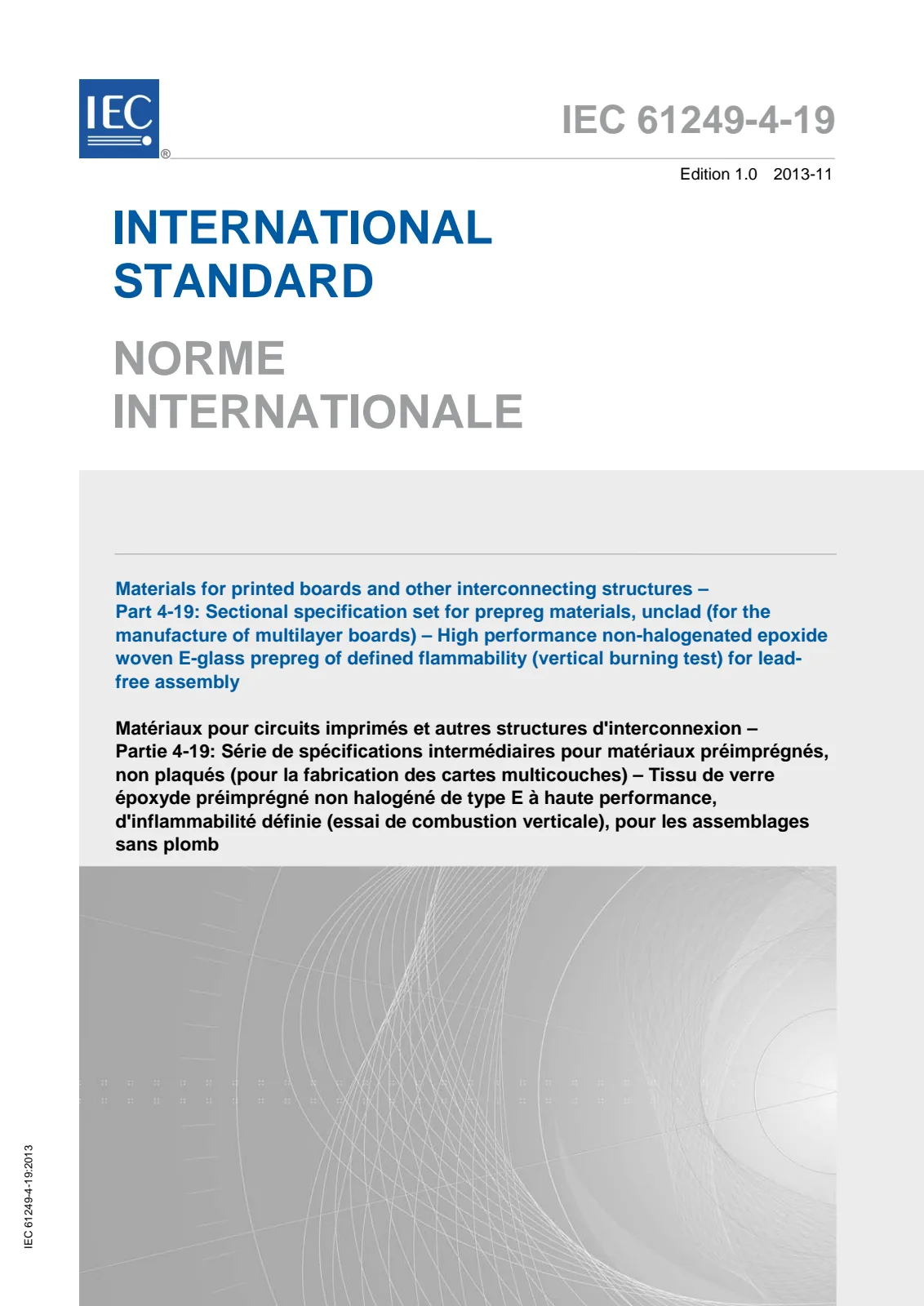 Open preview (PDF)Materials for printed boards and other interconnecting structures - Part 4-19: Sectional specification set for prepreg materials, unclad (for the manufacture of multilayer boards) - High performance non-halogenated epoxide woven E-glass prepreg of defined flammability (vertical burning test) for lead-free assembly