ISO 17327-1:2018 PDF
Non-active surgical implants — Implant coating — Part 1: General requirements
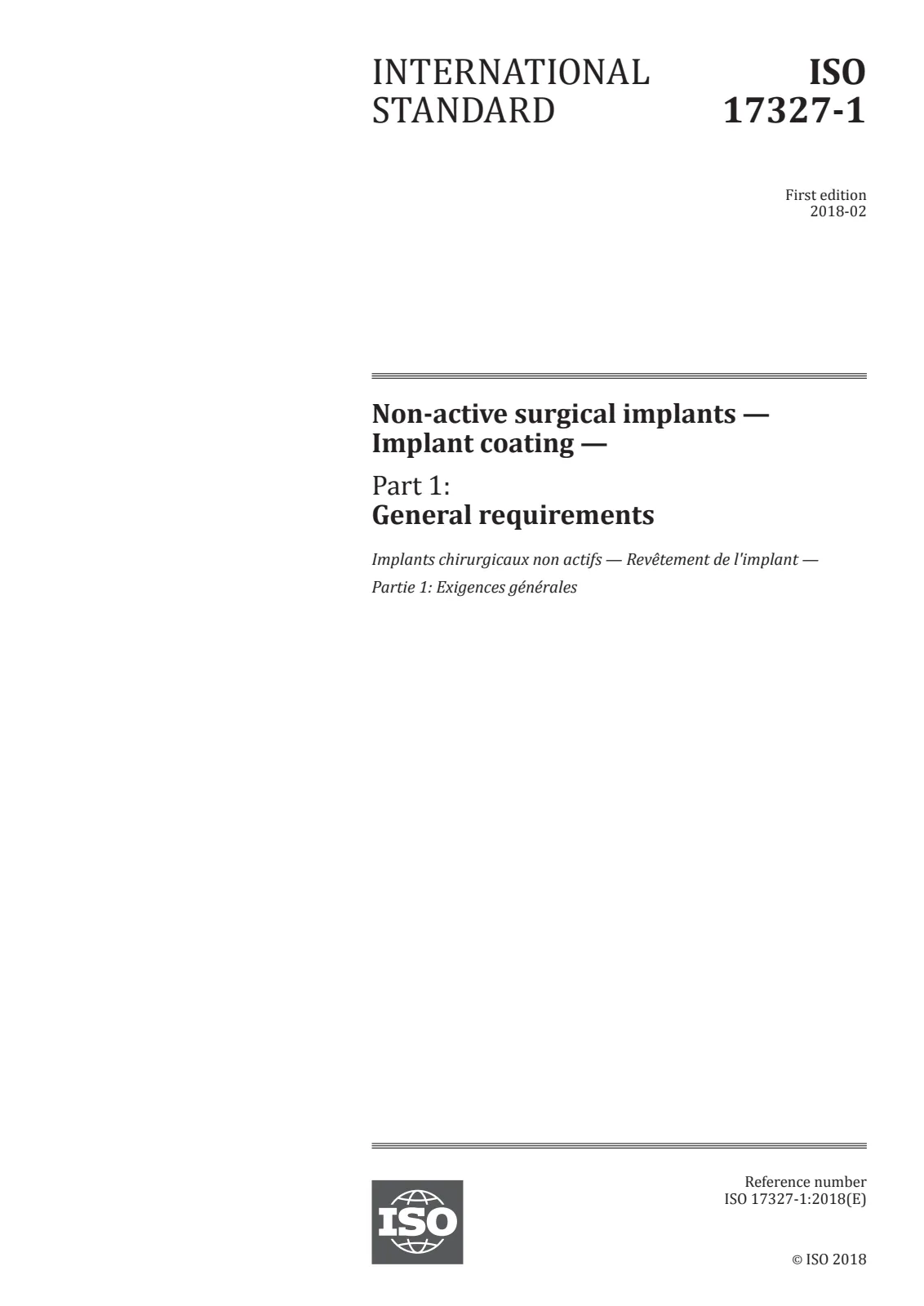
Non-active surgical implants — Implant coating — Part 1: General requirements
- Document status:
- Active
- Format:
- Electronic (PDF)
- Number of pages:
- 15
- Publication date:
- February 16, 2018
- Edition:
- ISO IS 17327 edition 1 version 1
- ICS:
- 11.040.40
ISO 17327-1:2018 specifies general requirements for implant coatings, comprising both surface coatings and surface modifications, applied to non-active surgical implants. This document specifies requirements concerned with generic coating properties including chemical and phase compositions, surface texture, coating coverage integrity, dissolvability, coating thickness, adhesion strength, abrasion resistance, porosity and pore size, and surface wettability. ISO 17327-1:2018 is applicable to surface coatings, which are defined as layers of material with any different property than the natural surface of the substrate which are intentionally added to the substrate. ISO 17327-1:2018 is applicable to surface modifications, which are defined as intentional conversion or reconstruction of the surface of the original substrate to form a new surface material consisting of components of the substrate's own material and possibly foreign material and forming a surface layer with different properties. Since the pertinent properties of a coating and their needed level of characterization are highly dependent on the intended application of the implant, the generic nature of the general requirements in this document is not intended to either override or replace the provisions of application-specific performance standards. ISO 17327-1:2018 is not applicable to surfaces modified by texturing with the exclusive intention to change the roughness of the surface or the strength of the raw material. ISO 17327-1:2018 is not applicable to natively passivated metal surfaces. While this document is applicable to intentionally passivated metal surfaces, well-established materials passivated by conventional techniques, such as nitric acid immersion, are usually non-hazardous and can be described in a very basic manner. ISO 17327-1:2018 is not applicable to implant coatings utilizing viable tissue. ISO 17327-1:2018 is not applicable to laminates, i.e. composite materials made of multiple layers, e.g. vascular prosthesis constructed of different expanded polytetrafluoroethylene layers, except the exposed surface of the laminate, which can be an implant coating (see 3.1, note 2 to entry). ISO 17327-1:2018 is not applicable to coverings, e.g. covered stents. NOTE 1 ISO 17327-1:2018 does not contain requirements on biocompatibility. Nevertheless, this is a critical property of the device and coating and needs to be addressed during risk assessment. NOTE 2 ISO 17327-1:2018 supplements applicable non-active surgical implant standards and ISO 14630. NOTE 3 ISO 17327-1:2018 does not require that manufacturers have a quality management system in place. However, the application of a quality management system, such as that described in ISO 13485, could be appropriate to help ensure that the implant achieves its intended performance. NOTE 4 Although fully porous implants are not coatings, some of the considerations in this document can also be applied to them.
Technical details
- Technical committee
- ISO/TC 150 - Implants for surgery
- SKU
- ISO 17327-1:2018