Overview
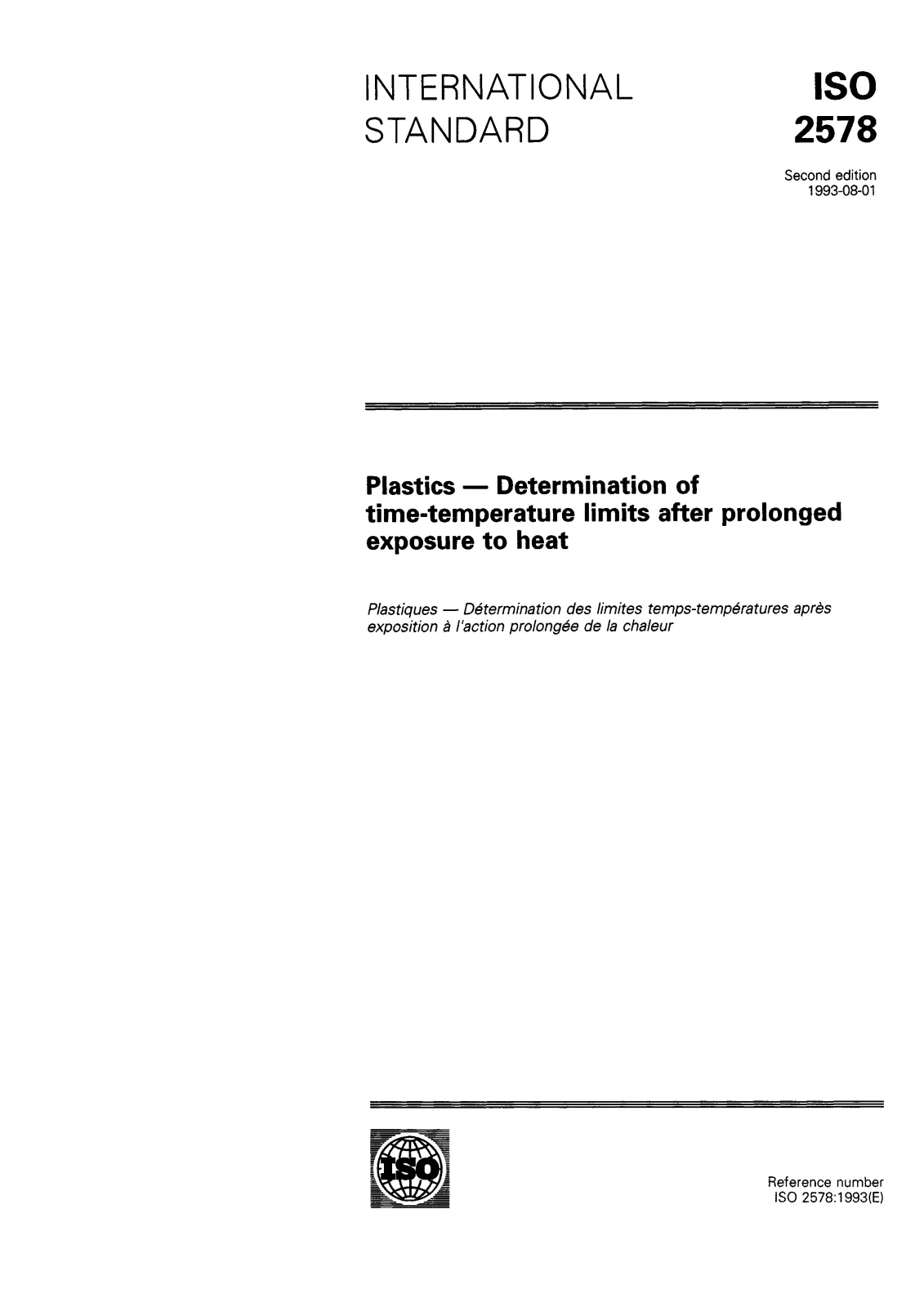
ISO 2578:1993 - Plastics - Determination of time‑temperature limits after prolonged exposure to heat - specifies principles and procedures to evaluate the thermal endurance of plastics exposed to elevated temperature for long periods. The standard bases thermal ageing evaluation solely on changes in selected properties measured after specimens have returned to ambient temperature. It provides a method to derive a temperature index (Tl) and relative temperature index (RTI) using Arrhenius‑type time–temperature evaluation.
Key topics and technical requirements
- Scope and principle
- Evaluates long‑term heat ageing in air (thermal endurance) by measuring property change after cooling to room temperature.
- Assumes an Arrhenius relation between log(time to failure) and reciprocal absolute temperature (linear Arrhenius plot).
- Test specimens and preparation
- Specimen dimensions and preparation follow the relevant test method; conditioning at the lowest exposure temperature is required (48 h for thermosets).
- Processing and orientation must be consistent between materials when comparing RTI.
- Exposure temperatures and ovens
- Expose specimens at not less than three temperatures selected to give times to failure across a usable range (recommended lowest time ≥ 5 000 h; highest ≥ 100 h; typical extrapolation time 20 000 h).
- Use ageing ovens meeting ventilation and temperature tolerances (see IEC 216‑4).
- Endpoint, failures and measurements
- Choose a practical threshold value (often 50% of initial property) or an agreed absolute limit; measure property change at each heat‑ageing interval.
- Determine time to failure at each temperature and plot on logarithmic time scale.
- Data analysis
- Plot log(time to failure) vs reciprocal absolute temperature (Arrhenius graph).
- Calculate a first‑order regression line (Annex A) and evaluate linearity using the correlation coefficient (Annex B); r ≥ 0.95 is recommended for reliable extrapolation.
- Derive Tl at a chosen time (commonly 20 000 h) and RTI by comparative testing with a reference material.
- Documentation
- Test report requirements and annexed calculation guidance are included (clauses 11–13, Annex A–C).
Practical applications
- Establishing service temperature limits and long‑term performance expectations for polymer components.
- Comparing heat‑ageing resistance between formulations (RTI) for material selection.
- Supporting specifications for electrical, automotive, building, and industrial plastics where long‑term heat resistance is critical.
- Aiding accelerated ageing test design and extrapolation to predict lifetime.
Who should use this standard
- Materials engineers, R&D chemists, polymer formulators, quality managers, test laboratories, and product designers requiring standardized long‑term thermal endurance data for plastics.
Related standards
- IEC 216 series (guides for determination of thermal endurance properties)
- ISO 291 (standard atmospheres for conditioning and testing)
- ISO 2578 includes Annexes A–C for regression calculations, correlation assessment and recommended test schedules.

 Open preview (PDF)Plastics — Determination of time-temperature limits after prolonged exposure to heat