ISO 4965-1:2012 PDF
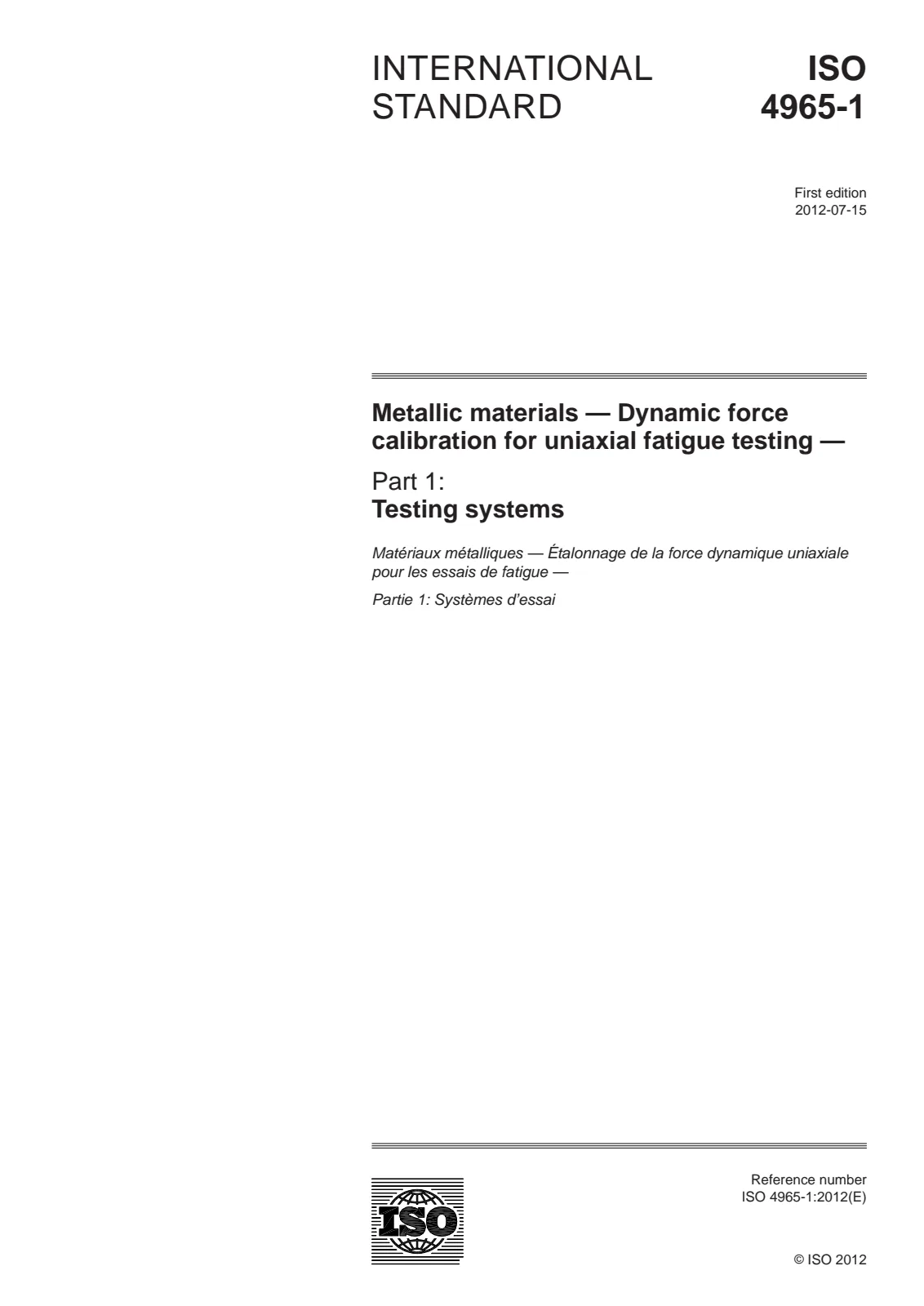
Metallic materials — Dynamic force calibration for uniaxial fatigue testing — Part 1: Testing systems
 Open preview (PDF)Metallic materials — Dynamic force calibration for uniaxial fatigue testing — Part 1: Testing systems
Metallic materials — Dynamic force calibration for uniaxial fatigue testing — Part 1: Testing systems
- Document status:
- Active
- Format:
- Electronic (PDF)
- Number of pages:
- 13
- Publication date:
- July 6, 2012
- Edition:
- ISO IS 4965 edition 1 version 1
- ICS:
- 77.040.10
ISO 4965-1:2012 describes two methods for determining the relationship between the dynamic force range applied to a test-piece in a uniaxial, sinusoidal, constant amplitude test and the force range indicated by the testing system. These methods are applicable to dynamic testing systems operating away from system resonant frequencies and are relevant to testing systems where the dynamic force measurement errors are either unknown or where they are expected to exceed 1 % of the applied force range. The dynamic force measurement errors are determined by comparison of the peak forces indicated by the dynamic testing system with those measured by the strain gauged dynamic calibration device (DCD). This DCD has previously undergone static calibration against the testing system indicator. For Method A (Replica test-piece method), the dynamic calibration is applicable over the validated range of frequencies for that type of test-piece only. A frequency-dependent correction factor is applicable for the correction of dynamic force measurement errors of up to 10 % of dynamic force range. By using such a correction factor, the actual test specimen dynamic force measurement error will be reduced to less than 1 % of the dynamic force range. For Method B (Compliance envelope method), the dynamic calibration is applicable over the range of test frequencies validated for test-pieces whose compliance lies between those of the two DCDs. No correction factor is applicable, as Method B does not permit dynamic force measurement errors above 1 % of the dynamic force range.
Technical details
- Technical committee
- ISO/TC 164/SC 4 - Fatigue, fracture and toughness testing
- SKU
- ISO 4965-1:2012