Overview
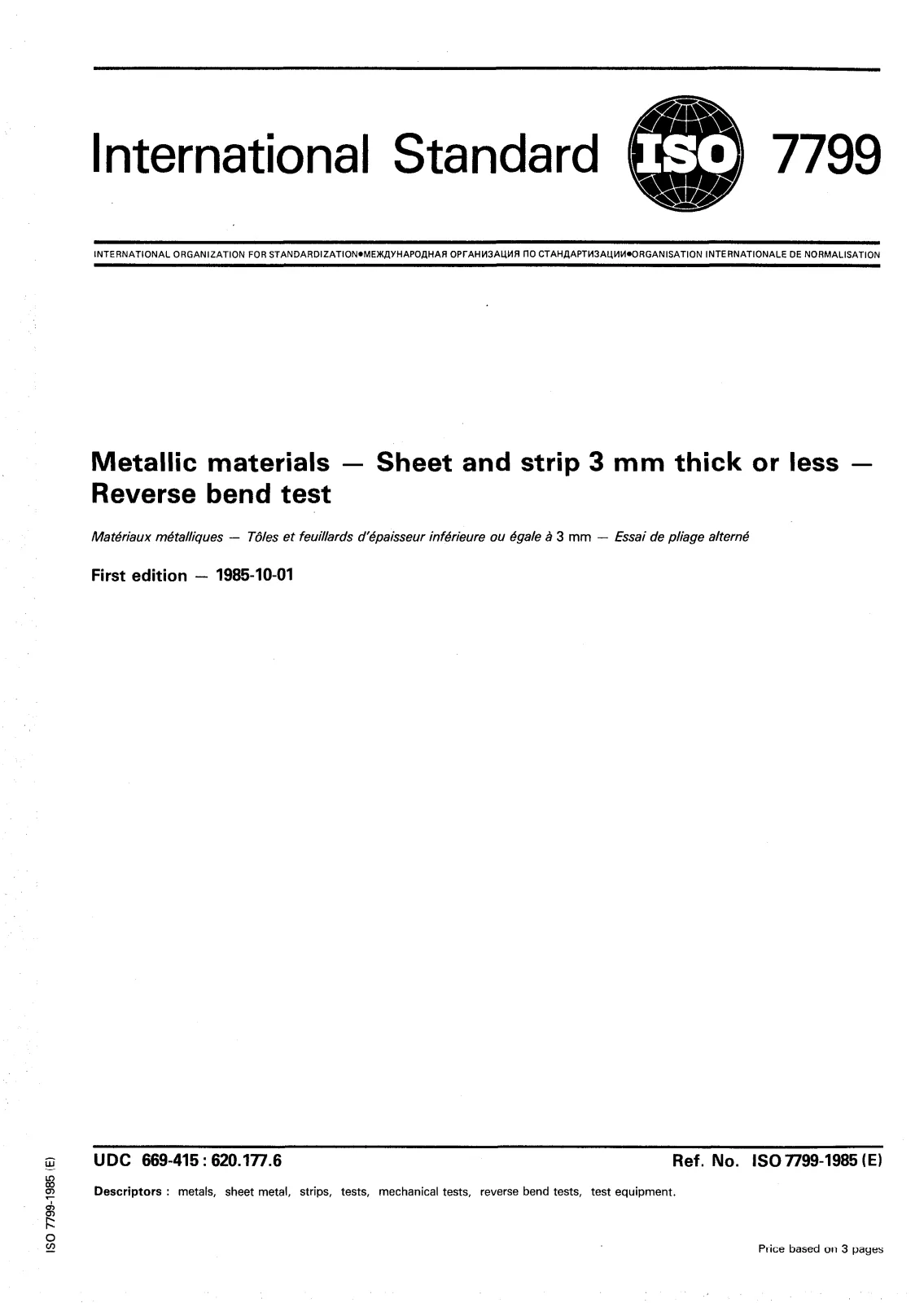
ISO 7799:1985 specifies the reverse bend test for metallic sheet and strip 3 mm thick or less. The standard defines a repeatable method to determine a material’s ability to undergo plastic deformation by repeatedly bending a rectangular test piece 90° in alternating directions over cylindrical supports of specified radius. It is applicable to metallic sheets and strips; application to aluminium and its alloys is allowed only after prior mutual agreement. ISO 7799 supersedes the earlier ISO/R 88-1959 (first edition 1985).
Key topics and requirements
- Scope: Sheet and strip of thickness ≤ 3 mm; aluminium/alloys only by agreement.
- Specimen: Rectangular test piece; thickness as taken from the product including mill skins; machined width normally 20–25 mm (narrower strips may be tested as supplied).
- Test principle: Repeated bending of the free end of a held specimen through 90° alternately in opposite directions, the bend wrapping over a cylindrical support.
- Supports and jaws:
- Cylindrical supports and jaws must be sufficiently hard and wear resistant.
- Axes of cylindrical supports must be perpendicular to the plane of bending and parallel to each other (within 0.1 mm).
- Support apex position relative to jaws: distance y = 1.5 mm for r ≤ 25 mm; y = 3 mm for r > 25 mm.
- Distance between top of supports and underside of guide (h) between 25 and 50 mm.
- Machine geometry: Pivot axis distance from support apex = 1.0 mm.
- Test conditions:
- Temperature: ambient 10–35 °C; controlled tests at 23 ± 5 °C.
- Bending speed: not to exceed one bend per second; reduce speed if heating affects results.
- Continuous contact between specimen and supports should be maintained; an optional tensile load up to 2% of nominal tensile strength may be applied if specified.
- End criteria and reporting:
- Repeat bends until the number specified in product standard or until a visible crack appears (without magnification).
- The bend that causes rupture is not counted in the reported number of bends.
- Test report must include reference to ISO 7799, specimen ID and dimensions, test conditions (support radius, h, applied load), end criterion, and results.
Applications
- Assessing ductility and resistance to alternating bending for thin metallic sheets and strips.
- Quality control and acceptance testing in metal producing and processing industries.
- Material selection for forming, stamping, or cyclic bending applications.
- Use by metallurgists, test laboratories, quality engineers, product specifiers, and standards bodies.
Related standards
- Developed by ISO/TC 164 (Mechanical testing of metals).
- ISO 7799 replaces ISO/R 88-1959.