ISO/IEC 24730-62:2013 PDF
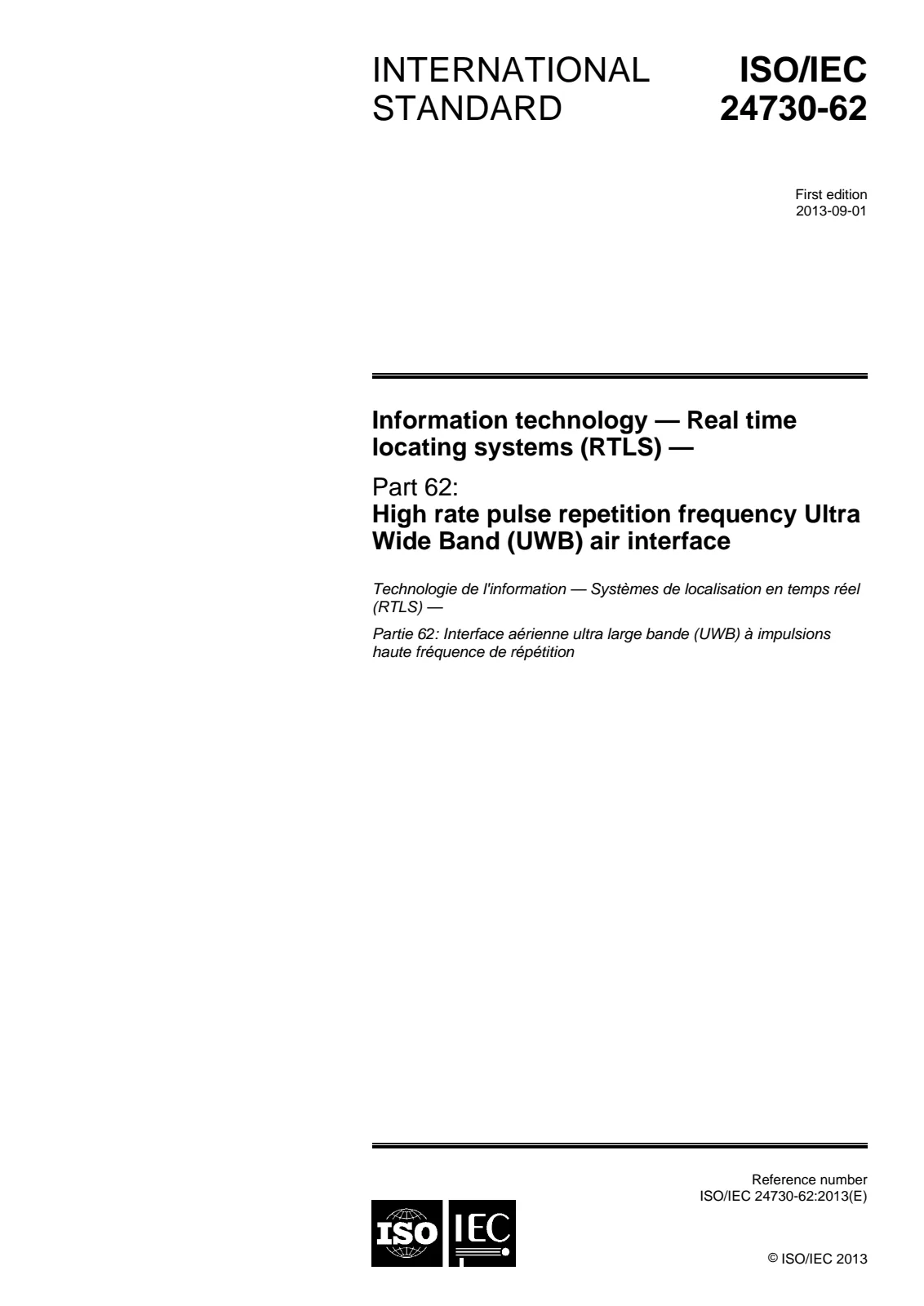
Information technology — Real time locating systems (RTLS) — Part 62: High rate pulse repetition frequency Ultra Wide Band (UWB) air interface
 Open preview (PDF)Information technology — Real time locating systems (RTLS) — Part 62: High rate pulse repetition frequency Ultra Wide Band (UWB) air interface
Information technology — Real time locating systems (RTLS) — Part 62: High rate pulse repetition frequency Ultra Wide Band (UWB) air interface
- Document status:
- Active
- Format:
- Electronic (PDF)
- Number of pages:
- 57
- Publication date:
- August 26, 2013
- Edition:
- ISO/IEC IS 24730 edition 1 version 1
- ICS:
- 35.040
ISO/IEC 24730-62:2013 defines the air-interface for real time locating systems (RTLS) using a physical layer Ultra Wide Band (UWB) signalling mechanism (based on IEEE 802.15.4a UWB). This modulation scheme employs high rate pulse repetition frequencies (PRF) 16 MHz or 64 MHz, and a combination of burst position modulation (BPM) and binary phase-shift keying (BPSK) giving an extremely high level of performance with a fully coherent receiver. In addition to defining the air interface protocol (AIP) in terms of the physical layer modulation, ISO/IEC 24730-62:2013 also defines the AIP in terms of the messages sent over the air. This AIP supports simple one-way communication of a basic blink that may be used for a one-way Time Difference of Arrival (TDOA) based RTLS, where mobile tags periodically transmit the blink message which is received by an infrastructure consisting of a number of fixed reader nodes. This AIP also optionally supports bidirectional communication and two-way ranging between the readers and tags of an RTLS. The support of two-way ranging depends on additionally including a UWB receiver in the tag and UWB transmitters in the reader infrastructure. The mandatory default operational mode ensures interoperability between tags and infrastructure from various manufacturers, while the availability of several options offers flexibility to the developer of the infrastructure to adapt the behaviour of the overall system to the specific needs of his application.
Technical details
- Technical committee
- ISO/IEC JTC 1/SC 31 - Automatic identification and data capture techniques
- SKU
- ISO/IEC 24730-62:2013